 Sociability
and aggression.
Sociability
and aggression.HOME | Lab members | Research projects | Prospective students | Publications | Cognitive Ecology II | e-mail | Links
We examine the evolutionary biology of cognition, defined as the neuronal processes concerned with the acquisition, retention and use of information. We prefer to work with insects and have studied various species of solitary and social bees, flies, wasps and grasshoppers. See Publications for recent papers and reviews on the topics below.
Sociability
and aggression.
Expertise and
perseverance.
We are interested in addressing the mechanisms and
evolutionary biology of animal expertise, and the role of perseverance in the
development of superior performance. See the recent review on this new reserach
topic (Dukas 2019)
Older, currently inactive projects in the lab:
Ecology and evolution of social behaviour and social learning. We are interested in social learning, defined as learning from other individuals, because it has had dramatic effects on some species including humans, in whom it has generated a rich culture. Social learning has mostly been studied in a few vertebrates and social insects. We are currently conducting experiments with a few non-social insect species with the goal of understanding the evolution of and neurogenetic mechanisms underlying social learning in particular and social behaviour in general.
Adaptive significance of learning in fruit flies. Fruit flies (Drosophila spp) have been a prime model system in the fields of evolution and neurogenetics. We integrate mechanistic and evolutionary knowledge for quantifying how flies benefit from learning in the context of sexual behaviour and nutrient choice.
Effects of learning on evolution. It is widely believed that phenotypic plasticity in general and learning in particular have contributed significantly to evolutionary change (see Robinson & Dukas 1999, Dukas 2004, Servedio & Dukas 2013). There are, however, few data sets supporting this proposition. We are trying to study this unresolved issue through theory and empirical work with fruit flies.
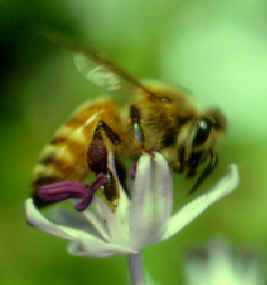 Life
history of learning. Learning is one of a few
factors that contribute to an increase in individual performance throughout life
in many animals including humans. In spite of the importance of learning, no
experimental research program has critically quantified the relative contribution of
learning to performance throughout the lifespan. We
use honey bees and bumble bees as model systems for measuring how learning, physiology and effort
interact to affect foraging success throughout workers' lifetime
under natural settings and in controlled experimental environments. This work is
highly relevant for our understanding of topics such as the development of
expertise and senescence, and their combined effects on performance at different
stages of life in all animals including humans.
Life
history of learning. Learning is one of a few
factors that contribute to an increase in individual performance throughout life
in many animals including humans. In spite of the importance of learning, no
experimental research program has critically quantified the relative contribution of
learning to performance throughout the lifespan. We
use honey bees and bumble bees as model systems for measuring how learning, physiology and effort
interact to affect foraging success throughout workers' lifetime
under natural settings and in controlled experimental environments. This work is
highly relevant for our understanding of topics such as the development of
expertise and senescence, and their combined effects on performance at different
stages of life in all animals including humans.
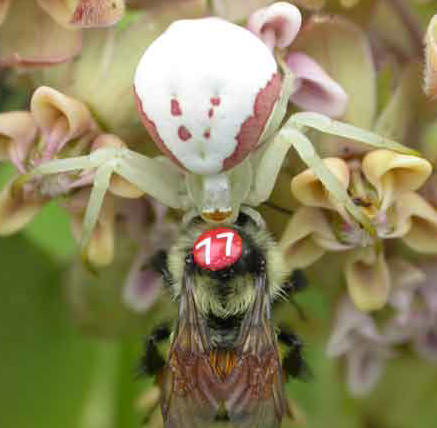 Predation
and pollination. Research on animal-flower
interactions has traditionally focused only on two trophic levels. We have
examined how pollinators' predators influence these interactions and documented
that some predators, such as bumblebee wolves, can have large negative effects
on bee density and plant fitness. Other predators such as crab spiders have
small and variable effects. We recently found that honey bees consider danger in
their waggle dance.
Predation
and pollination. Research on animal-flower
interactions has traditionally focused only on two trophic levels. We have
examined how pollinators' predators influence these interactions and documented
that some predators, such as bumblebee wolves, can have large negative effects
on bee density and plant fitness. Other predators such as crab spiders have
small and variable effects. We recently found that honey bees consider danger in
their waggle dance.
See recent publications from my lab for further details.
Updated November 08, 2018 12:10 PM